A Tribute to Anton Ölzelt
History of a Landmark
Legend has it that Crown Prince Rudolf and Mary Vetsera secretly met in what is now the Gmoakeller, which is why the place was known as "Zum Kronprinzen" (To the Crown Prince) for a long time. In 1858, the building and inn were built by master builder Anton Ölzelt the Elder.
Around the mid-18th century, the Imperial and Royal Cavalry Barracks were built south of today's Marokkanergasse, later known as the Transport Barracks, and finally, from the 1840s onwards, the Heumarkt Barracks. This extensive barracks complex was demolished at the beginning of the 20th century, with the land parcelled out and partially developed.
East of the Heumarkt, city architect Anton Oelzelt (1817-1875) acquired several plots of land, which he developed with residential buildings in the 1850s. All of them feature the typical, detailed decor of Romantic Historicism, sometimes combined with elements of the English Tudor style. Before 1846, Oelzelt worked in Znaim, among other places, and from 1850 he was an Imperial and Royal Court Architect. From 1856 to 1860, he worked as a builder for Ferstel's Austro-Hungarian Bank on the Freyung.
The building at Heumarkt 25, corner of Marokkanergasse 1 or Oelzeltgasse 12, was also the work of city architect Anton Oelzelt. An inn has been located there since its construction in 1858. The street level was at the height of today's service road, so it's likely there was a garden for guests even back then.
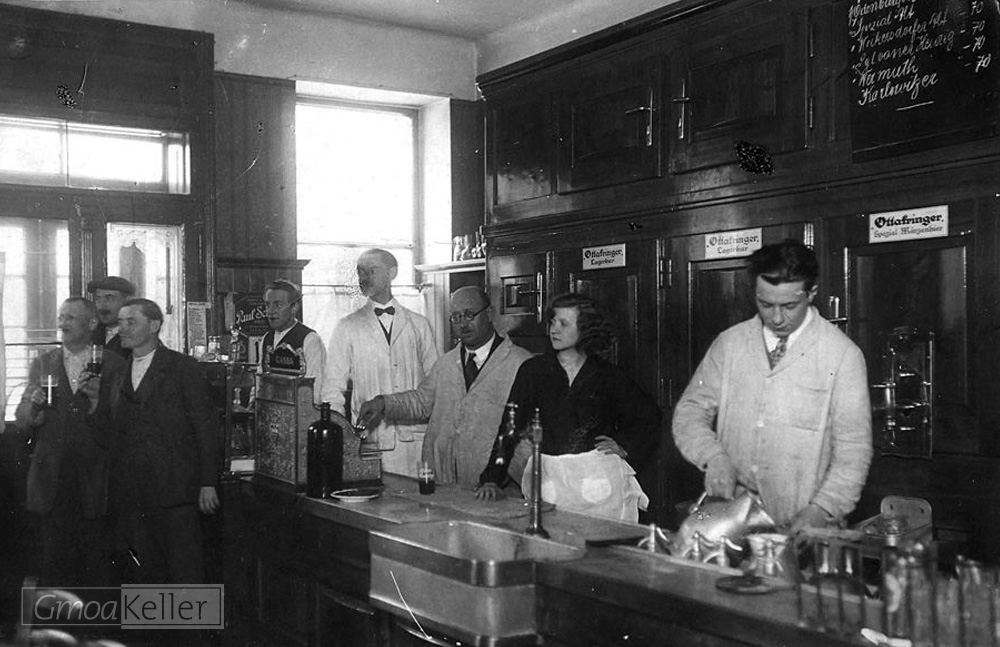
A typical Viennese inn had a black oiled floor, green painted windows, and – at least partially – wood-paneled walls with coat hooks. The heart of the guest room was the bar, with its tin cover and built-in glass washing sink, behind which was the cooling system with taps for beer and soda water. Until after the war, cooling was still done with ice blocks delivered by large ice wagons. Pass-throughs to the kitchen were popular, and nearby you'd find the regulars' table for especially dear guests or family members. The area around the regulars' tables was often decorated with holiday greetings or original photos of regular guests hanging on the walls.
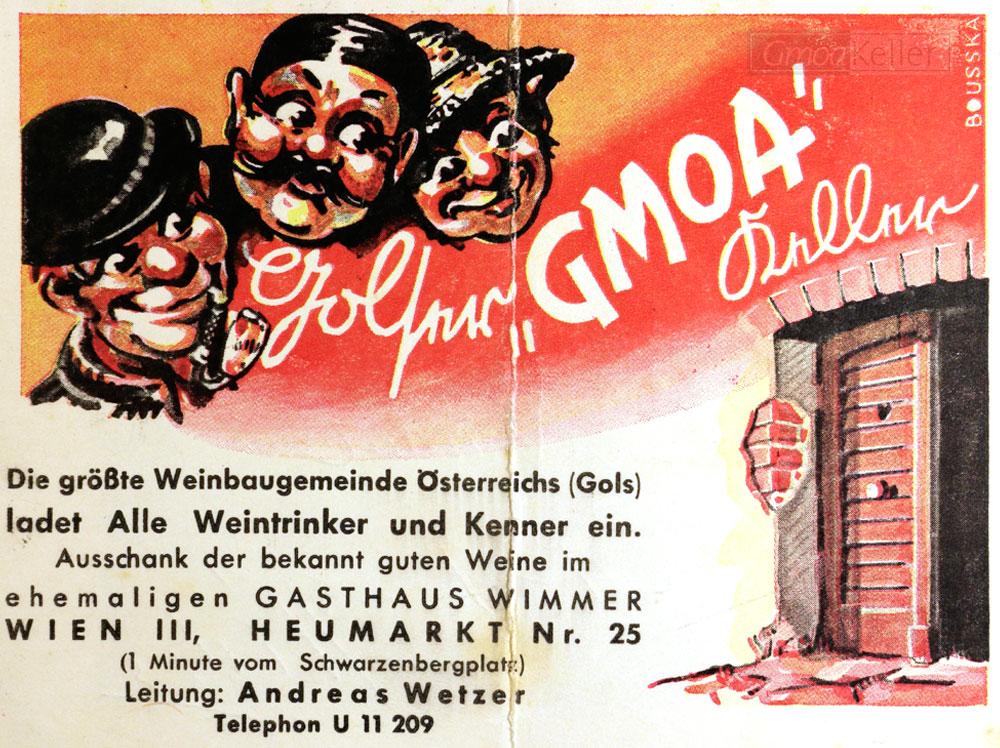
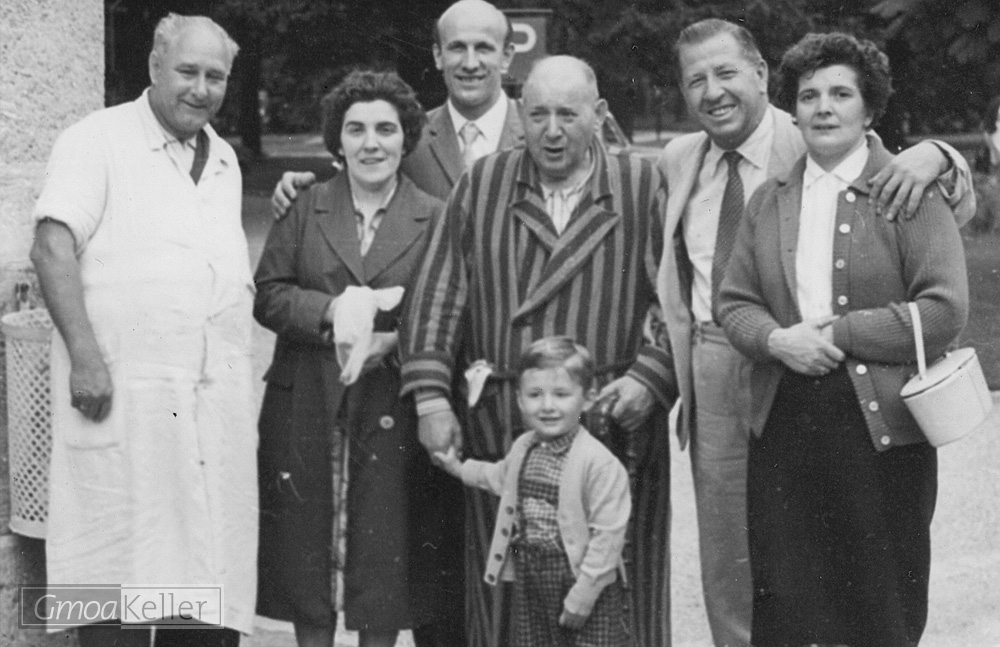
Around 1940, Andreas Herzog acquired the Wimmer inn "Zum Kronprinzen" and started wholesaling Golser wines. Herzog came directly from Sopron and ran not only the inn but also a wine trade with Golser wine. Somehow, the Golser Gmoa-Keller really became like a "village inn" for the surrounding area: it was the hub for important local news, and many families even left their apartment keys there. Even the local "neighborhood celebrities" had their regular tables at the Gmoa-Keller.
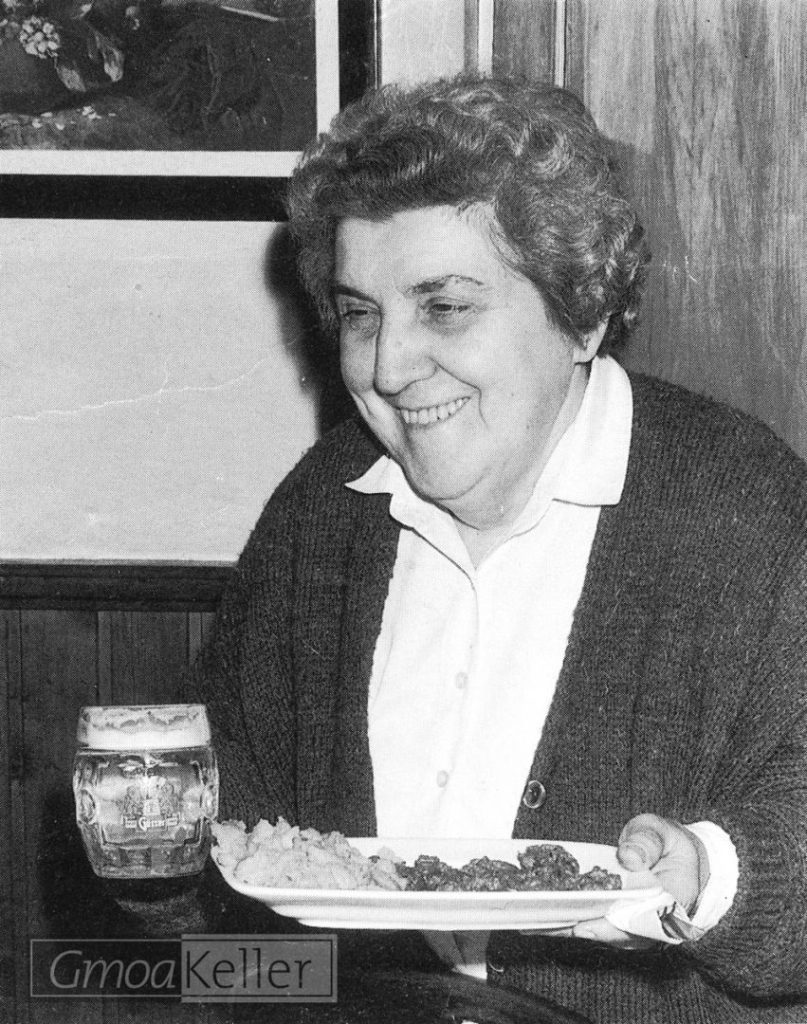
Back in the day, up to seven waiters handled the guest service at Gmoakeller. Later, the owner Grete Novak managed it all by herself, with the help of one relative (usually Hungarian, like Rozsi, Marika, or Vera) and with regulars pitching in, because everyone was responsible for "their" table and had to serve "their" own people.
In the queue at the bar or in front of the kitchen, you'd find musicians, actors, ambassadors, cabaret artists, and even clergy standing among ordinary folks, waiting for their beer, wine, an "Obi-G'spritzt" (a type of spritzer), goulash, or Beuschl (a traditional offal dish). If things got busy, especially trusted regulars were even allowed to wash a few glasses.
After the war, lots of political bigwigs came to the place, especially since many party conferences were held at the Konzerthaus (most other venues were destroyed). We know that Figl, Pittermann, Schärf, Körner, and Raab all visited. Things often got lively late into the night, so much so that the staff would crash on the big pub tables just to be able to open on time the next morning. During the Hungarian Revolution in 1956, many members of the Herzog family came to Vienna from Sopron. At first, they were just happy to find shelter with Uncle Andreas. Up to fifteen family members slept in two rooms and three small cabinets in the apartment connected to the pub. For the seven kids, the main pub room became their living room and adventure playground.
In 1956, the Herzog family (that was the maiden name of the four sisters Grete, Mitzi, Hedi, and Gizi) came from Sopron to join their relatives already living in Vienna. Because of this, Hungarian was the everyday language in the kitchen. However, in the guest area, Mitzi and Grete chatted in Viennese, just like people used to do in old Ödenburg.
After her uncle passed away around 1960, Grete took over the pub. It did pretty well until the 70s. In the post-war years, jazz was played in the cellar, which was home to the "Vienna Hot Club," and legends like Joe Zawinul and Fatty George even played there! The bowling alley (!) was also heavily used by the construction workers building the Hotel Intercontinental.
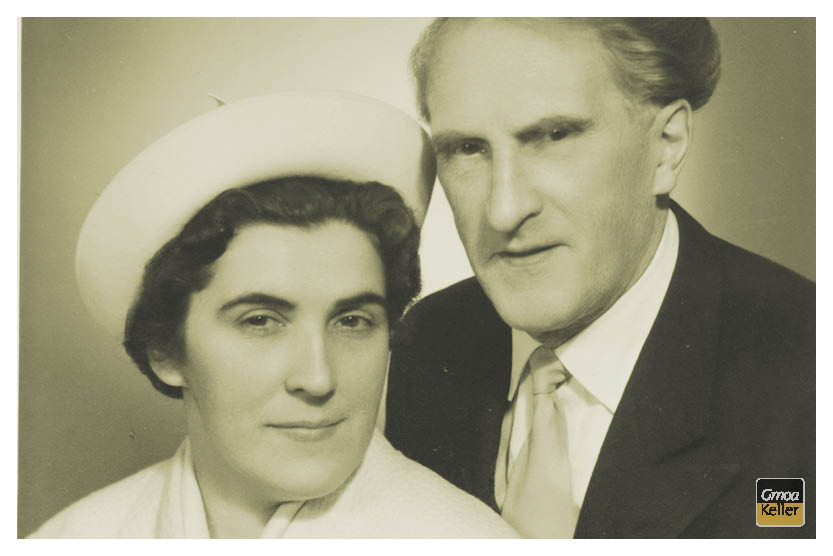
When she was almost 40, she married Novak, a French horn player with the Vienna Philharmonic, who was 20 years her senior. After a short but very happy marriage, the pub truly became the center of her world. She regularly visited her husband's grave every Sunday until the very end, as long as her health permitted.
During the "pub dying out" era, things weren't going so well for Gmoa-Keller either. But around 1970, the place was rediscovered by a bunch of young actors. Music students, choir singers, and journalists helped bring in a younger crowd, as did foreign flight crews who stayed at the Hotel Intercont and loved typical Viennese pubs. World-famous philharmonic orchestras would even drop by after concerts, and more and more celebrities started celebrating their birthdays or launching books here.
In autumn 1998, Grete Novak was awarded the Golden Decoration of Honour of the Republic of Austria for her "remarkable contributions to local pub culture." She was also an honorary citizen of Vienna-Landstraße and received the Golden Medal of Merit from the city of Gols.
After Grete Novak passed away on February 9, 1999, her sister Hedvig Vécsei (née Herzog), at 81 years old, took over the place (where she had already worked for twenty years alongside Grete and Mitzi). She did this to make sure the GmoaKeller would continue in Grete's spirit – meaning, as unchanged as possible. Hedvig Vécsei passed away on May 18, 2010, in Vienna.
Within a generation, not much of that has stuck around. The new places are brighter, easier to clean, with matching curtains and tablecloths, and of course, central heating and perfectly clean toilets. For decoration, old household items are often hung on the walls, and the furniture is mostly rustic – but all new, because a bit of age isn't really in style anymore.
Menus are now international, pushing out classics like roasted potatoes, breaded Leberkäse, or sausages with gravy. New eating habits are replacing the old ones, a process that slowly but surely moves forward over many years. Suddenly, an old-school pub becomes a rare find, and it can even turn into a celebrity hangout precisely because both the decor and the menu seem to have stopped in time.
A really lovely example of such a Viennese pub is the (Golser) Gmoa-Keller.
The entrance door was usually glass, often with another door – or sometimes a thick curtain – acting as a draft shield. Each of these doors made a distinct sound, so unconsciously, an acoustic signal was part of entering your favorite local pub. Also typical for a Viennese inn was the smell of roasted onions or goulash, and that lazy vibe on hot summer days when only a few guests were around, leaving plenty of time for often very personal conversations. Pass-throughs to the kitchen were popular, and near them, you'd find the regulars' table for special guests or family members. The area around these regulars' tables was often decorated with holiday greetings or unique photos of the regulars, hanging on the walls.